|
Emergency Oxygen Systems
Quick Care® Emergency Oxygen Unit Specification and Benefits
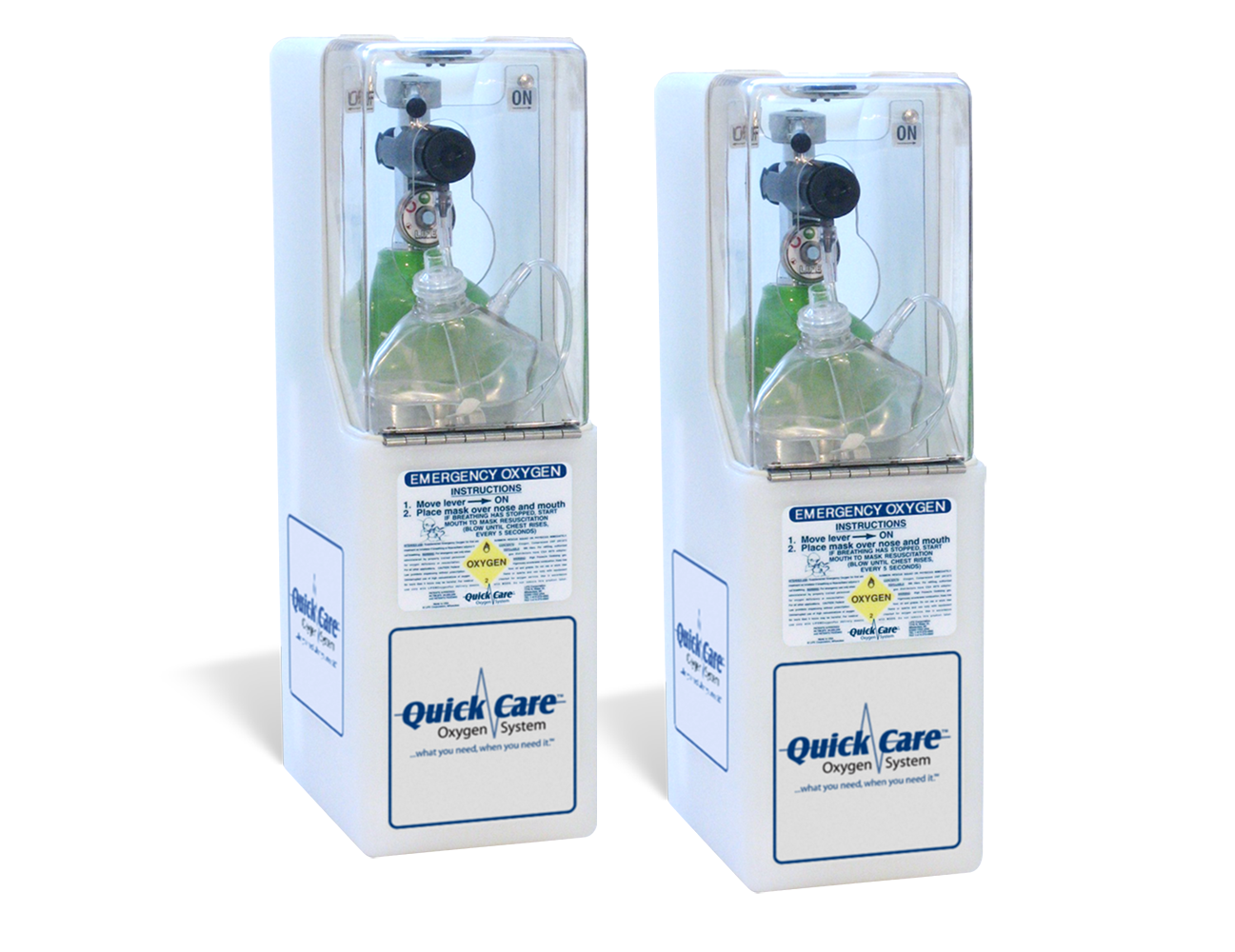
Attractive, portable, single-step operation unit provides 45 minutes of USP oxygen at 12 liters per minute.
Unique case design allows you to see how much oxygen is available at all times, and without activating unit.
Dual purpose mask has one way valve to protect person administering CPR and delivers oxygen during CPR... Mask is durable and easy to sterilize.
Prominently displayed simple two step instructions are on the outside of the durable protective case.
Summary of
EMERGENCY OXYGEN ADMINISTRATION
From the 2005 American Heart Association Guidelines for CPR
Part 4: Basic Life Support (BLS)
During CPR the purpose of ventilation is to maintain adequate oxygenation …. therefore, both ventilations and compressions are important for victims of prolonged ventricular fibrillation SCA, when oxygen in the blood is utilized. Ventilations and compressions are also important for victims of asphyxial arrest, such as children and drowning victims who are hypoxemic at the time of cardiac arrest. Mouth-to-Mask Rescue Breathing and Bag-Mask Ventilation – Masks should include an oxygen inlet.
…use supplemental oxygen … at a flow rate of 10 to 12 LPM
…to enable delivery of 100% oxygen (initially).
Part 7.1: Adjuncts for Airway Control and Ventilation - recommendations for the support of ventilation and oxygenation during resuscitation and the periarrest period. The purpose of ventilation during CPR is to maintain adequate oxygenation and elimination of carbon dioxide. To improve sufficient oxygenation,
…give 100% inspired oxygen during Basic Life Support (BLS).
…and Advanced Cardiac Life Support (ACLS) …as soon as it becomes available.
High inspired oxygen tension will tend to maximize arterial oxygen saturation and, in turn, arterial oxygen content. This will help support oxygen delivery when cardiac output is limited.
… short term oxygen therapy does not produce oxygen toxicity
(... and should not be withheld for fear of suppressing respiration. - ref.2000 AHA)
Part 7.5: Post-Resuscitation Support - the provider should support adequate airway and breathing and…administer supplemental oxygen.
Part 9: Adult Stroke … several studies showing improved functional outcomes and survival in which higher supplementary oxygen concentrations were used …administer supplemental oxygen to hypoxemic stroke patients and those with unknown oxygen saturation.
Part 10.5: Near-Fatal Asthma - Primary Therapy – Oxygen
Provide oxygen to all patients with severe asthma, even those with normal oxygenation.
Part 10.6: Anaphylaxis – Intervention to Prevent Cardiopulmonary Arrest
…administer oxygen at high flow rates.
|